
Safety and operation tutorials, showreel
Scenes from VB's safety and SOP tutorial films in one minute.
1:09 · VB Engineering channel · 2023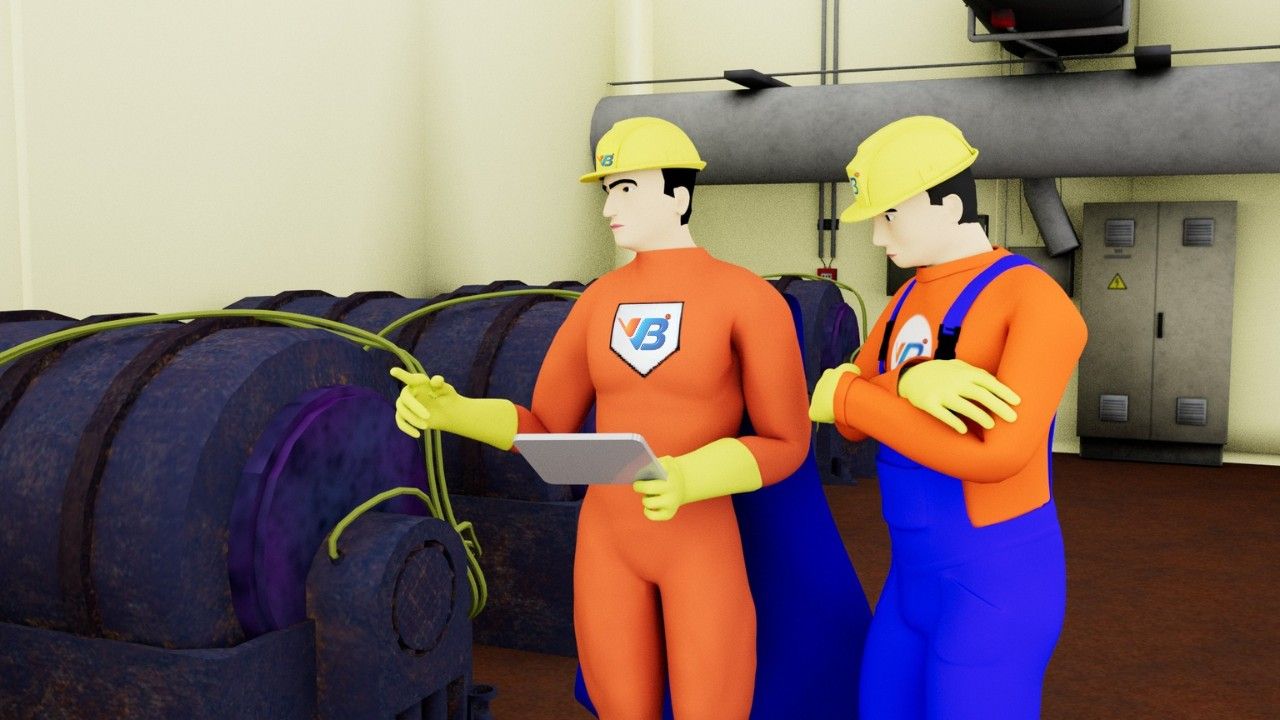
3D safety animation · SOP and induction films · incident recreation · 3D factory animation
VB Engineering produces 3D safety training, SOP, visitor induction and incident recreation animations for industrial plants. Each film is modelled on your plant's own drawings, CAD model or laser scan, scripted with a VB engineer from the hazard's discipline, and voiced in your workforce's languages. Tell us what the film must teach; the production plan on the right updates as you choose.
Since 201421 countriesScripts checked by engineersMultilingual voice-over
| Production | 4 to 5 weeks 3-minute safety film · 2 languages · from 2D drawings |
|---|---|
| You receive | Script and storyboard for sign-off · full-HD MP4 per language · subtitle files · still frames for toolbox talks and posters |
| We need | The hazard or SOP in writing · layout and equipment drawings of the area · one reviewer from your EHS team |
Indicative production plan, modelled (category 3) on VB's production method, October 2026, for one site and two review rounds. The price and the confirmed plan come with the estimate after a VB engineer reads your brief. Short form, no phone number.







































Source: VB Engineering project register, October 2026.
The answer
A 3D safety animation is a computer-generated film that shows a workplace hazard, how an incident unfolds and the controls that prevent it, without putting anyone at risk. VB Engineering builds each film on the plant's own layout, equipment and procedures, with the script checked by a VB engineer, so workers see their own plant rather than a stock factory.
An SOP animation turns a written standard operating procedure into a step-by-step visual guide. An induction film shows visitors and contractors the site rules, routes and emergency points before they enter. An incident recreation rebuilds what happened, second by second, for a root cause analysis. A 3D factory animation, or walkthrough, flies through the plant for training, a customer or an approval. All five are produced the same way at VB: model the plant, script with an engineer, animate, voice, review.
| Film | What it does | Who uses it | Typical length | Built from |
|---|---|---|---|---|
| Safety training animation | Shows one hazard, how it injures and the controls that stop it | EHS head, shift supervisors, toolbox talks | 1 to 5 minutes | The plant area and the equipment involved |
| SOP animation | Turns a written procedure into steps a new operator can follow | Production and quality heads, trainers | 2 to 8 minutes per SOP | The SOP, the machine and its controls |
| Visitor and contractor induction | Site rules, PPE, routes, muster points, permits, before entry | EHS, security, HR and admin | 3 to 6 minutes | Site plan, gate, routes and emergency points |
| Incident recreation | Rebuilds an incident from evidence for the investigation and the lesson | EHS head, investigation team, management | 1 to 4 minutes | Incident report, photos, drawings, statements |
| Process and equipment animation | Shows how a line, a machine or a process works inside | Plant and projects heads, training | 2 to 5 minutes | Process flow, equipment drawings, simulation model |
| 3D factory walkthrough | Flies through the whole plant, inside and out | Plant head, corporate communications | 2 to 4 minutes | Layout, CAD model or laser scan |
VB's own work
VB has produced electrical shock, lifting and hoisting, forklift and visitor induction safety films, operation tutorials, process animations and 3D factory walkthroughs, published on VB's own channel. Five are below and the induction film is in the case further down. Each plays here; nothing loads from YouTube until you press play.
Scenes from VB's safety and SOP tutorial films in one minute.
1:09 · VB Engineering channel · 2023
An electrical incident in a generating station, shown as it unfolds.
0:29 · VB Engineering channel · 2022
A suspended-load incident for crane and rigging toolbox talks.
0:20 · VB Engineering channel · 2022
A material-handling incident for warehouse and stores induction.
0:23 · VB Engineering channel · 2022
A filling and packing line shown in motion, station by station.
3:06 · VB Engineering channel · 2022
A manufacturing plant flown through from the gate to the line.
1:33 · VB Engineering channel · 2022When plants commission one
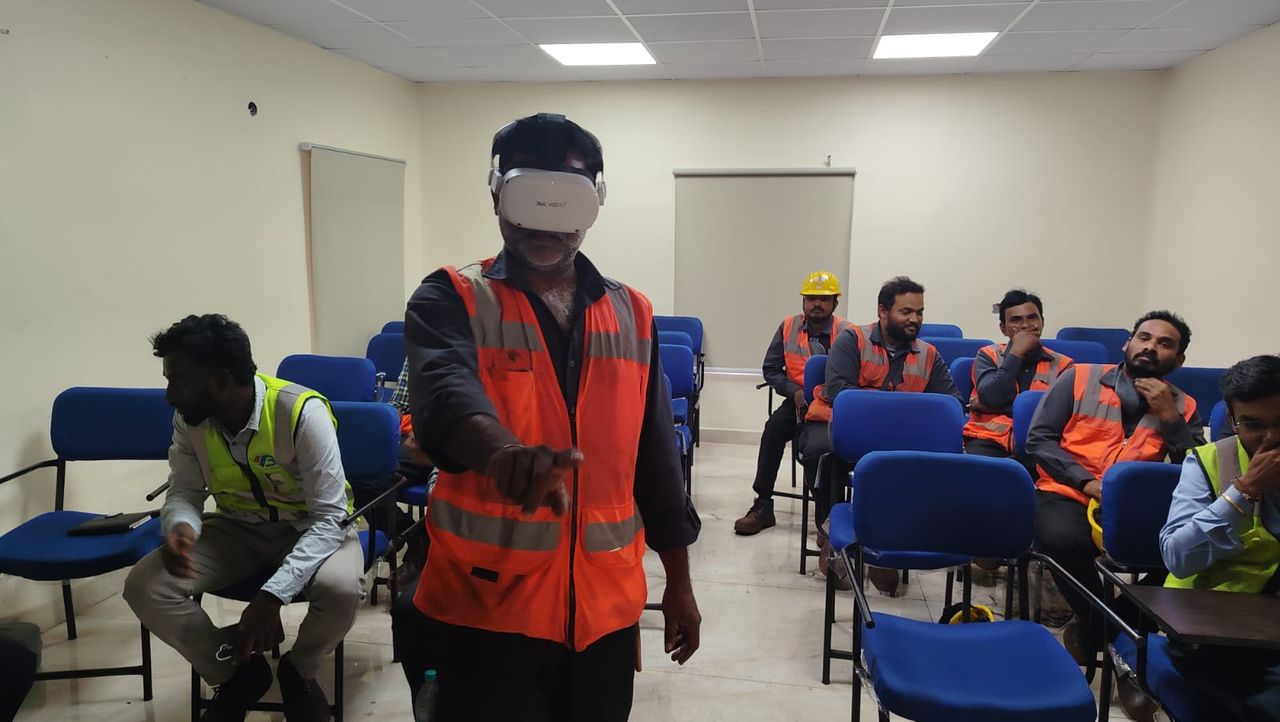
Plants commission a safety or SOP animation when a lesson has to reach every worker the same way, fast: a new line or plant before start-up, a revised SOP, an incident or near miss that must not repeat, an audit finding on training, a contractor-heavy shutdown, or a workforce that speaks several languages.
Built from your plant
Yes. VB builds the 3D scene from whatever the plant already holds: a CAD or 3D model, a laser scan, 2D layout and equipment drawings, or photos and a site visit. A laser scan or CAD model gives the most exact scene; drawings and photos are enough for most safety films. Where nothing exists, VB scans the area with a Leica RTC360 and models from the point cloud.
| What the plant holds | What VB builds from it | Accuracy on screen | Effect on production |
|---|---|---|---|
| CAD or 3D model (plant design model, equipment models) | The scene imported and dressed, equipment to the model | Exact geometry and layout | Fastest start |
| Laser scan, yours or by VB | The area modelled from the point cloud, as built today | As-built, including what drawings missed | Adds a scan day if VB scans |
| 2D layout and equipment drawings | The area modelled from plan and elevations | Layout exact, details to the drawings | Standard |
| Photos and a site visit only | The area modelled from photographs and measurements | Recognisable, details simplified | About one week more |
The same model is kept. When the next SOP or the next hazard on that line needs a film, VB starts from the scene already built. Plants that want the model for engineering can take it into an as-built engineering or laser scanning scope.
Engineering-led subjects
VB animates hazards its engineering teams study every week: arc flash and electrical shock, process safety work such as permits, lockout and confined space, GMP procedures in pharma, forklift and lifting operations, and incident recreation for root cause analysis. The engineer who knows the hazard reviews the script, so the controls shown on screen are the ones that work.
The approach boundaries, the PPE category and the label at the panel, shown the way an arc flash study defines them. From the team behind VB's arc flash studies.
Permit to work, lockout and tagout, confined space entry and hot work, scripted with VB's HAZOP and process safety engineers.
Gowning, line clearance, cleaning and changeover as animated SOPs, from the team that designs pharmaceutical plant layouts.
Pedestrian routes, load handling, blind corners and suspended loads, set in your own stores and bays.
The sequence rebuilt from the investigation evidence, second by second, for the root cause analysis and the lesson to every site.
Visitor, contractor and new-joiner inductions with your gate, routes, muster points and permit rules.
What you receive
Every VB animation project delivers the script and storyboard for your sign-off, the finished film as full-HD MP4 in each language, subtitle files, still frames for posters and toolbox talks, and the 3D scene kept for the next film. 4K masters, short phone cuts for WhatsApp groups and screen loops for the canteen are delivered on request.
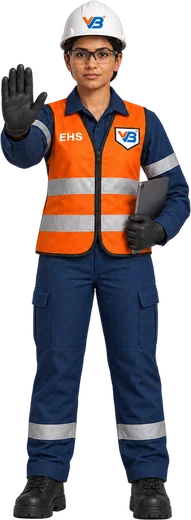
VB's films use characters in the PPE your plant issues: the helmet colours, the coveralls, the vest, the gloves. A worker should recognise the person on screen as someone on the shift.
Character from VB's own safety character set.
How it is priced
A 3D safety animation is priced per finished minute, and four things set the rate: how much of your own plant has to be modelled, how many characters and actions the scenes carry, how many languages are voiced, and how many review rounds you need. VB returns a price estimate for your film after an engineer reads the brief.
A scene built from your CAD model or scan costs less than one modelled from photos. A second film on the same scene reuses the model.
One worker at one panel is simpler than a crew, a forklift and a crane in one scene. The storyboard fixes the count before animation starts.
Each language adds voice-over, subtitles and a check by a native speaker. The animation itself is made once.
Two rounds are standard: storyboard and first cut. Further rounds are priced as lines, so changes never arrive as surprises.
Five SOPs on one line share the scene, the characters and the voice talent. A series costs less per minute than five separate films.
When the procedure is written and approved, the script is a translation, not an investigation. The film moves faster.
Method
A three-minute safety or SOP animation takes about four to six weeks at VB from brief to final film, in four stages: brief and plant data, script and storyboard sign-off, 3D modelling and animation, then voice, languages and final review. A series on one line runs faster per film because the scene is already built.
The hazard or SOP, the audience, the languages and the drawings, model or scan of the area.
Written with a VB engineer, signed off by your EHS or process owner before anything is animated.
The plant scene built, the characters in your PPE, the sequence animated to the storyboard. First cut for review.
Voice-over and subtitles in each language, second review, final films and still frames delivered.
Durations indicative, modelled (category 3) for a three-minute film in two languages from 2D drawings; the confirmed plan comes with the estimate.
A case, anonymised
Take a large manufacturing site in India that inducts visitors, drivers and contractors at the gate every day. VB's three-minute 3D visitor induction film shows the site's gate, walking routes, PPE rules and emergency points, and plays at the security cabin before entry, so every person entering hears the same rules in the same order.
| Measure | Before | With the film |
|---|---|---|
| Induction at the gate | Verbal briefing by the guard on duty | A three-minute film, identical for every visitor |
| What every visitor hears | Varies by guard and by shift | The same rules, routes and muster points |
| Languages | Whatever the guard speaks | The visitor's choice of language |
| Record for audits | A register signature | Signature against a fixed, dated film |

Factory visitor safety induction, 3D animation by VB.
3:04 · VB Engineering channelAfter the film
Yes. The scene VB builds for a film is a 3D model of your plant, so it can become an immersive VR training module in Drona VR, a walk-through visit in 360Vista, or the visual layer of a WisTwin digital twin, without modelling the plant twice.
The cheapest way to reach every worker: a screen, a phone, a toolbox talk.
The same scene in VR lets a worker perform the procedure, not only watch it.
The model becomes the visual base for asset and safety data on the plant.
Every step reuses the scene, so the second product costs less than the first.
Engineering behind the film
VB's animations draw on the same engineering tools its teams use for studies: point clouds from Leica laser scanners for as-built scenes, FlexSim models for process and line motion at real rates, and ETAP and SKM PowerTools studies when an electrical scene must show the boundaries and PPE the study calculated.
Before you brief us
A 3D safety animation is a computer-generated film that shows a workplace hazard, how an incident unfolds and the controls that prevent it, without putting anyone at risk. VB Engineering builds each one on the plant's own layout, equipment and procedures, with the script checked by a VB engineer, so workers see their own plant rather than a stock factory.
VB prices a 3D safety animation per finished minute. Four things set the rate: how much of your plant has to be modelled, how many characters and actions the scenes carry, how many languages are voiced, and how many review rounds you need. A series of films on one line costs less per minute than separate films. Send the brief and VB returns a price estimate.
A three-minute safety or SOP animation takes about four to six weeks at VB from brief to final film: one week for the brief and plant data, a week for script and storyboard sign-off, about three weeks to model and animate, and a final week for voice-over, languages and review. A plant with only photos adds about a week.
Yes. VB models the scene from your CAD or 3D model, a laser scan, 2D layout and equipment drawings, or photos and a site visit. Characters wear the PPE your plant issues. Where no drawings or model exist, VB can scan the area with a Leica RTC360 laser scanner and model it from the point cloud.
VB needs four things: the hazard, SOP or incident in writing; drawings, a model, a scan or photos of the area; the languages your workforce speaks; and one reviewer from your EHS, production or quality team who can sign off the storyboard and the first cut. A VB engineer writes the script with that reviewer.
Yes. VB animates the film once and delivers a voice-over and subtitle version for each language your shift speaks, including Hindi, regional Indian languages, Arabic for Gulf sites and English. Each language version is checked by a native speaker before delivery, and on-screen text is kept to a minimum so the picture works in every language.
Incident recreation animation rebuilds an industrial incident in 3D from the investigation evidence: the incident report, photographs, drawings and witness statements. VB animates the sequence second by second so the investigation team can test what happened, and management can share the lesson with every site in a form that a written report rarely achieves.
Yes. VB turns pharma SOPs such as gowning, line clearance, cleaning and changeover into step-by-step animations of the plant's own rooms and equipment. The approved SOP is the script, so the film shows exactly the written steps, and the still frames can be placed in the SOP document and training records.
An animated video counts as part of the training, not all of it. OSHA 1910.178(l) for forklifts lists video among the forms of formal instruction, alongside practical training and an evaluation of the operator in the workplace. VB's films cover the formal instruction; your trainer completes the practical training and the evaluation on site.
Yes. The scene VB builds for a film is a 3D model of the plant, so it can become an immersive VR training module in Drona VR, a walk-through visit in 360Vista, or the visual layer of a WisTwin digital twin, without modelling the plant a second time. Each later product costs less because the scene already exists.
Animate when the hazard cannot be filmed safely, when the plant cannot stop for a camera crew, or when the film must show what happens inside equipment. Film live-action when the lesson is a simple routine in a room that is easy to shoot. VB produces 3D animation, which also lets one film be revoiced for every language without reshooting.
Tell us what the film must teach. A VB engineer reads the brief and returns the price estimate, the production plan and the storyboard approach.
Prefer to write? connect@groupvb.com with the film type in the subject line · or WhatsApp us from the chat button.
Your plant, scripted with engineers, voiced in your shift's languages.