
Does your plant need lightning protection, and to which code?
Start with an IS/IEC 62305-2 risk assessment. In India, lightning protection is decided by risk, not by a blanket rule: the assessment shows whether you need it, which class, and which code your inspector, insurer or parent company applies.
Does your plant need a lightning risk assessment now?
Two answers you already know. Your verdict appears here, with the code cited. No email needed.
Free · instant · based on IS/IEC 62305-2 and CEA Regulations 2023
Trusted by the World’s Most Demanding Plants.































































Which codes require lightning protection in India?
Four instruments decide it. IS/IEC 62305 is the Indian standard and sets the method. The CEA Safety Regulations 2023, the National Building Code and the oil industry guideline decide where it applies.
| Instrument | Clause | What it requires | When |
|---|---|---|---|
| IS/IEC 62305-2:2010 (BIS) | Part 2 · risk management | Calculate the risk of loss from lightning at the structure and compare it with the tolerable risk. Where the risk is higher, select protection measures and the lightning protection class (I to IV) that bring it below the limit. | At design, and whenever the structure, its use or contents change |
| CEA (Measures relating to Safety and Electric Supply) Regulations 2023 | Reg. 38(vi) | Multi-storeyed buildings above 15 m: lightning protection of the building as per the relevant standards. | At construction, and at inspection |
| National Building Code 2016 | Part 8, Section 2 | Lightning protection of buildings as part of electrical and allied installations, designed to IS/IEC 62305. | At design and building approval |
| OISD-GDN-180 | Lightning protection | Lightning protection of petroleum and hydrocarbon installations, including storage tanks and process units. | At design, and at OISD audit |
Editions matter. India adopted IEC 62305 as IS/IEC 62305:2010. IEC published Edition 3 of all four parts in 2024. Until BIS adopts it, Indian inspectors work to 2010, while a parent-company or insurer specification may cite 2024. VB states which edition each requirement comes from.
Not sure which code your inspector or parent company applies?
When does a plant need a fresh lightning risk assessment?
The standard sets no renewal date. The assessment is redone whenever something changes the risk it was based on.
Expanded, built taller or added hydrocarbons since your last assessment?
Who is responsible for lightning protection at a plant?
Four parties hold a part of it. The occupier carries the duty; the others check it.
- The owner or occupierProvides protection where the risk calls for it and keeps the assessment, design and test records.
- The electrical inspectorChecks installations against the CEA Safety Regulations 2023 at inspection, including buildings above 15 m.
- The design engineerCarries out the IS/IEC 62305-2 risk assessment, selects the class and signs the design basis.
- The insurer or parent companyAsks for the risk assessment and design against its own standard, often IEC 62305, NFPA 780 or an FM Global data sheet.
Is an ESE lightning arrester allowed in India?
An early streamer emission (ESE) arrester is an air terminal sold with a larger protection radius than a conventional rod. The question buyers ask is whether it is legal. The better question is whether the standard your inspector, insurer or parent company applies will accept it.
- IS/IEC 62305 has no design method for ESE terminals and does not credit them with a larger protection radius than a conventional rod.
- ESE systems are designed to a separate standard, NF C 17-102, which Indian codes do not reference.
- VB’s risk assessment states which design method each party will accept, before any hardware is bought.
How is an IS/IEC 62305-2 lightning risk assessment done?
Six steps, from site data to a signed report. The calculation is run in software, not by hand.
Collect structure data
Dimensions, height, construction, roof, contents, occupancy and the services that enter each building.Fix the strike density
Lightning ground flash density for the site location, and the surroundings that shield or expose each structure.Calculate the risk
Risk of loss of human life, of service and of economic value, from direct strikes and strikes near the structure and its lines.Compare with the tolerable risk
Where the calculated risk is higher than the tolerable limit, protection is required.Select the protection
The lightning protection class (I to IV), SPDs and bonding that bring the risk below the limit, at the lowest cost.Report and sign
A report with the risk before and after protection, the class selected and the codes each requirement comes from.What does the risk assessment give you?
Two outputs carry the proof: the protection zones on your plant plan, and the risk figures that justify them.
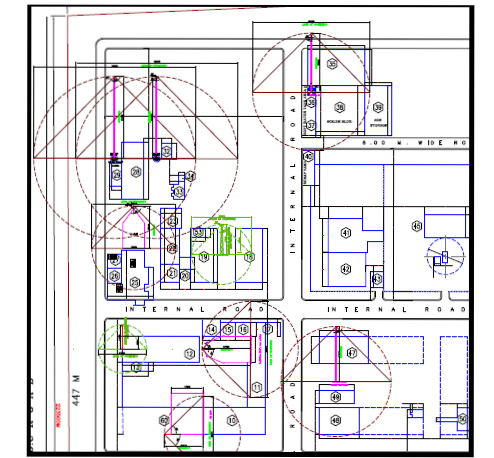 Protection zones on the plan
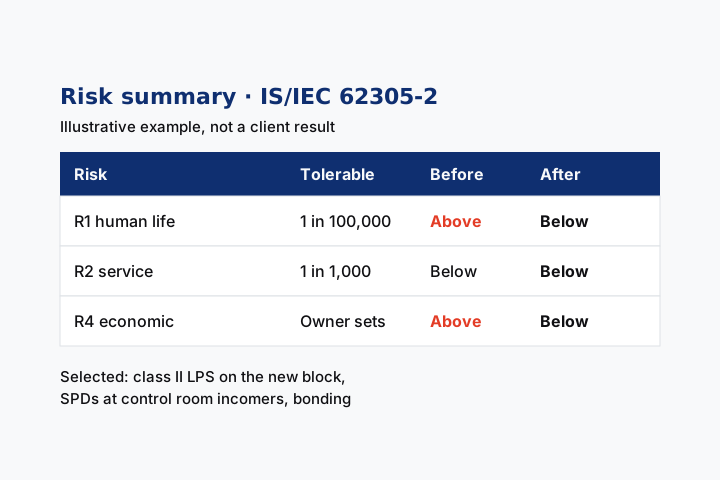 Risk before and after
Who signs the risk assessment?
The assessment is signed by a named engineer, not by a company. Three roles keep responsibility visible.
Reviewing engineer
Checks the input data and the risk calculation independently of the engineer who ran it.Electrical engineer of record
Named in the report and accountable for the class selected and the design basis.Code-mapped report
The signed report is the document an inspector, insurer or parent auditor asks to see.Illustrative case: a new block on an old design
Modelled on a typical finding, not a client record. A mid-size API pharma plant in western India added a solvent store and a taller production block. The lightning protection had been laid out years earlier to rod-spacing rules, with no risk assessment on record.
| What was checked | What was found |
|---|---|
| Risk assessment on record | None; the original layout followed rod spacing only |
| New block and solvent store | Outside the existing protection zones; calculated risk above the tolerable limit |
| Outcome | Class II protection for the new block, SPDs at the control room incomers, report mapped to IS/IEC 62305 and the parent standard |
Send this to the person who signs off your plant safety budget.VB Engineering capability brochure. One file, linked, not attached to this page.
Questions plant engineers ask about lightning protection rules in India
Is lightning protection mandatory for a plant in India?
It depends on risk and on what applies to the site. IS/IEC 62305-2 decides by risk whether protection is needed. CEA Regulations 2023, reg. 38(vi), require it for buildings above 15 m, and OISD-GDN-180 covers petroleum installations. Insurers and parent companies often require it regardless.
What is the Indian standard for lightning protection?
IS/IEC 62305, published by BIS in 2010 in four parts: general principles, risk management, physical damage to structures and life hazard, and electrical and electronic systems within structures. It is identical to IEC 62305:2010.
Is IS 2309 still valid, or has it been replaced by IS/IEC 62305?
IS 2309:1989 is the older Indian code of practice for lightning protection of buildings. BIS lists IS/IEC 62305:2010 as the current standard, and new designs follow its risk-based method. VB confirms the status of IS 2309 against your specification before the design starts.
At what height is a lightning arrester required?
CEA Regulations 2023, reg. 38(vi), require lightning protection to the relevant standards for multi-storeyed buildings above 15 m. Below that height there is no height rule: the IS/IEC 62305-2 risk assessment decides.
Is an ESE lightning arrester banned in India?
ESE arresters are sold in India, but IS/IEC 62305 has no method for them and does not credit them with a larger protection radius. Whether an ESE system is acceptable at your site depends on the code your inspector, insurer or parent company applies. VB states that before any hardware is bought.
What is an IEC 62305-2 lightning risk assessment?
It is the calculation in Part 2 of the standard that estimates the risk of loss from lightning at a structure, compares it with the tolerable risk and selects the protection measures needed to bring it below that limit.
What are the steps of an IEC 62305-2 risk assessment?
Collect structure and service data, fix the ground flash density for the site, calculate the risk components, compare the total with the tolerable risk, select the protection class and SPDs that bring it below the limit, and issue a signed report.
Does a plant expansion need a fresh lightning risk assessment?
Yes. A new block, a taller structure, hydrocarbon storage or new control systems changes the risk the original design was based on. The standard sets no fixed renewal date, so a change is what triggers a new assessment.
What changed in IEC 62305 in 2024, and does India still use the 2010 edition?
IEC published Edition 3 of all four parts in 2024. India adopted the 2010 edition as IS/IEC 62305 and BIS has not yet adopted the new one, so Indian inspectors work to 2010. A parent-company or insurer specification may cite 2024, and VB maps both.
What does an electrical inspector check in lightning protection?
For buildings above 15 m, that lightning protection exists and follows the relevant standards, as reg. 38(vi) of the CEA Regulations 2023 requires. In practice that means the design basis, the air terminals and down conductors as installed, and the earth test records.
Our parent company specifies NFPA 780 or IEC 62305. What do we follow in India?
Both. The Indian codes set the legal minimum, and the parent standard is a contractual requirement on top. VB’s risk assessment shows the design meeting IS/IEC 62305 and the parent standard together, with any difference between them stated.
Does the National Building Code require lightning protection?
NBC 2016 covers lightning protection of buildings in Part 8, Section 2, and refers to IS/IEC 62305 for design. Where a state adopts the NBC in its building rules, its lightning provisions apply to building approval.
Question not answered here? That is usually the one worth asking.
Where to go once you know what your plant needs
These pages take you from the rule to the work: the design, the audit of what is installed, and keeping it tested.
Lightning protection design
Air terminals, down conductors, earthing and SPDs designed, drawn and signed. How it is priced.
Already installedLightning protection audit
An audit and report of the system you have, for an inspector, insurer or parent audit.
Keep it workingInspection and testing
Periodic inspection and testing of the system, and what to do after a strike.
The earth endEarthing design
Earthing system design and the earth pits every lightning protection system ends in.
Tell us about your plant
Send the year of your last lightning risk assessment and what has changed since. We reply in writing with whether protection is needed, which class, and which code applies.
- We say whether a risk assessment is needed, and why
- We name the codes that apply: IS/IEC 62305, CEA, NBC, OISD and any parent standard
- You get the answer in writing whether or not you engage us
Find out where you stand
- A written answer from an electrical engineer, not a sales desk
- Your plant checked against IS/IEC 62305-2 and CEA reg. 38
- One site visit can cover lightning, earthing and arc flash together
Prefer to write? connect@groupvb.com · or WhatsApp us from the chat button