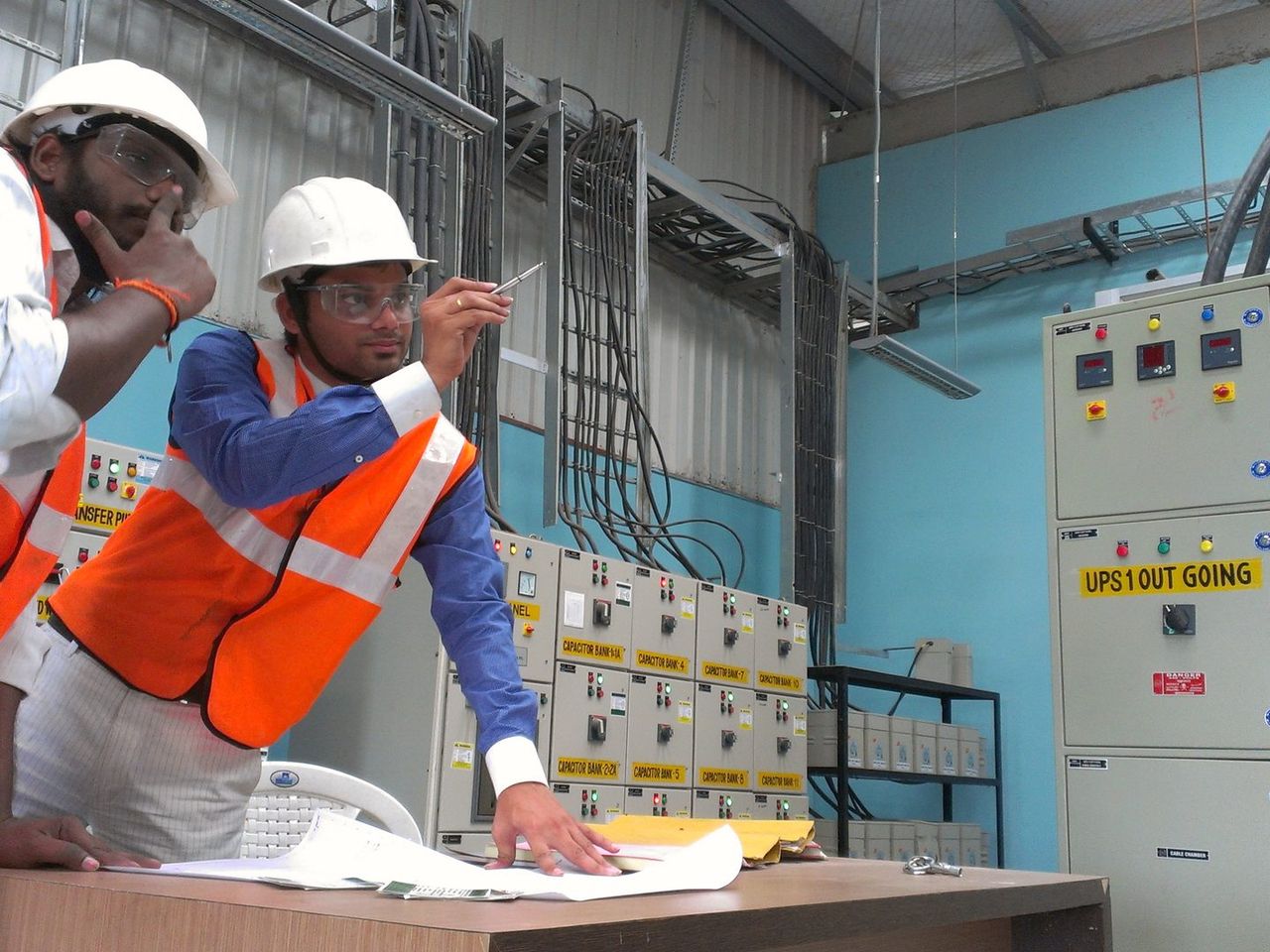
Data centre arc flash study · Saudi Arabia · UPS · battery storage · solar · AC and DC
Arc flash studies for Saudi data centres, power plants and battery storage, AC and DC.
VB calculates arc flash across your whole power chain: AC from the utility intake to the rack PDU, DC from the UPS battery string to the PV combiner box. We use IEEE 1584 for AC and the NFPA 70E Annex D methods for DC, then label every panel in Arabic and English. Riyadh, Dammam, Jeddah, NEOM: scope your site in 60 seconds.
AC and DC in one modelETAP and ElecTwinSigned by a named engineerArabic-English labels
Data centre and battery scope builder · 60 seconds
| Studies | |
|---|---|
| AC scope | |
| DC scope | |
| Hot spots | |
| Labels | |
| Duration |
An instant scope from your answers. Bus counts, DC points and durations are indicative bands, checked by a VB power systems engineer before anything is quoted. Submit and the full scope, the data list your team needs and the estimate in SAR reach your inbox within two working days. No phone number asked.
Trusted by the World's Most Demanding Plants.











- 0sides of the power chain, AC and DC, solved in one VB model
- 0DC, the top of the battery and PV range VB models on named DC methods
- 0the top of the IEEE 1584 AC range; everything above is flagged on a named method
- 0arc flash studies in VB's register since 2014
- 0languages on every label, Arabic and English, from one calculation
Studies delivered across Saudi Arabia from Riyadh to the Eastern Province and the Red Sea coast. AC range: IEEE 1584-2018, 208 V to 15 kV. DC methods: NFPA 70E Annex D. Study counts: VB Engineering project register.
The data centre study
What does a data centre arc flash study in Saudi Arabia cover?
A data centre arc flash study in Saudi Arabia covers every point where a technician can open live gear: the 13.8 kV or 33 kV utility intake, the medium-voltage ring, transformers, generator paralleling switchgear, the UPS input and output boards, static transfer switches, PDUs and remote power panels, and the DC side of every UPS battery string. VB calculates incident energy at each one and labels it in Arabic and English.
| Point in the power chain | Why it matters | What VB delivers there |
|---|---|---|
| Saudi Electricity Company (SEC) intake and MV ring, 13.8 kV or 33 kV | Highest fault level on site; 33 kV sits above the IEEE 1584 range | Named-method calculation, flagged per bus; protection review at the intake |
| Main LV switchboards and generator paralleling gear | Big transformers, slow incomers and generator sources in parallel | Incident energy for utility, generator and closed-transition modes |
| UPS input, output and bypass boards | Where operators switch most during maintenance and transfers | Board-level labels, PPE per task, maintenance-mode options |
| UPS battery strings and cabinets | DC energy that never switches off; outside IEEE 1584 | DC incident energy per string and cabinet on a named DC method |
| Static transfer switches, PDUs, RPPs and busway | High-density AI racks are pushing PDU fault energy up | Labels down to the PDU and tap-off box |
| Mechanical: chillers, CRAH and pump MCCs | Often fed from a separate board and missed in the model | Walked down, drawn in, calculated |
Your installation is built to SBC 401, the electrical part of the Saudi Building Code, and usually to your tenant's or owner's international standard as well. The VB arc flash study adds what neither drawing set gives your technicians: the incident energy, arc flash boundary and PPE for every board in the hall, in Arabic and English.
Building a petrochemical or refining scope instead? See petrochemical plant arc flash studies in Saudi Arabia. Want the full Kingdom-wide service, every industry? See VB's Saudi arc flash study service.
Beyond IEEE 1584
How does VB calculate arc flash on DC battery storage in Saudi Arabia when IEEE 1584 covers AC only?
At Saudi data centres and storage sites, VB calculates DC arc flash on battery storage with the DC methods in NFPA 70E Annex D, the maximum power method and the Stokes and Oppenlander arc model, solved in ETAP's DC arc flash modules. Each battery string, cabinet and DC busbar gets its own incident energy, boundary and PPE, in the same report and the same label set as the AC side.
- String by string. Cell count, internal resistance and cable runs captured on site, not assumed from a datasheet.
- Method named on the label. Every DC value says which method produced it, so an auditor can trace it.
- Fuses checked. VB confirms each DC fuse clears fast enough to keep the energy where the label says.
- One label set. AC and DC labels printed together, in Arabic and English, from one model.
Want the method in depth? See how VB calculates DC incident energy.
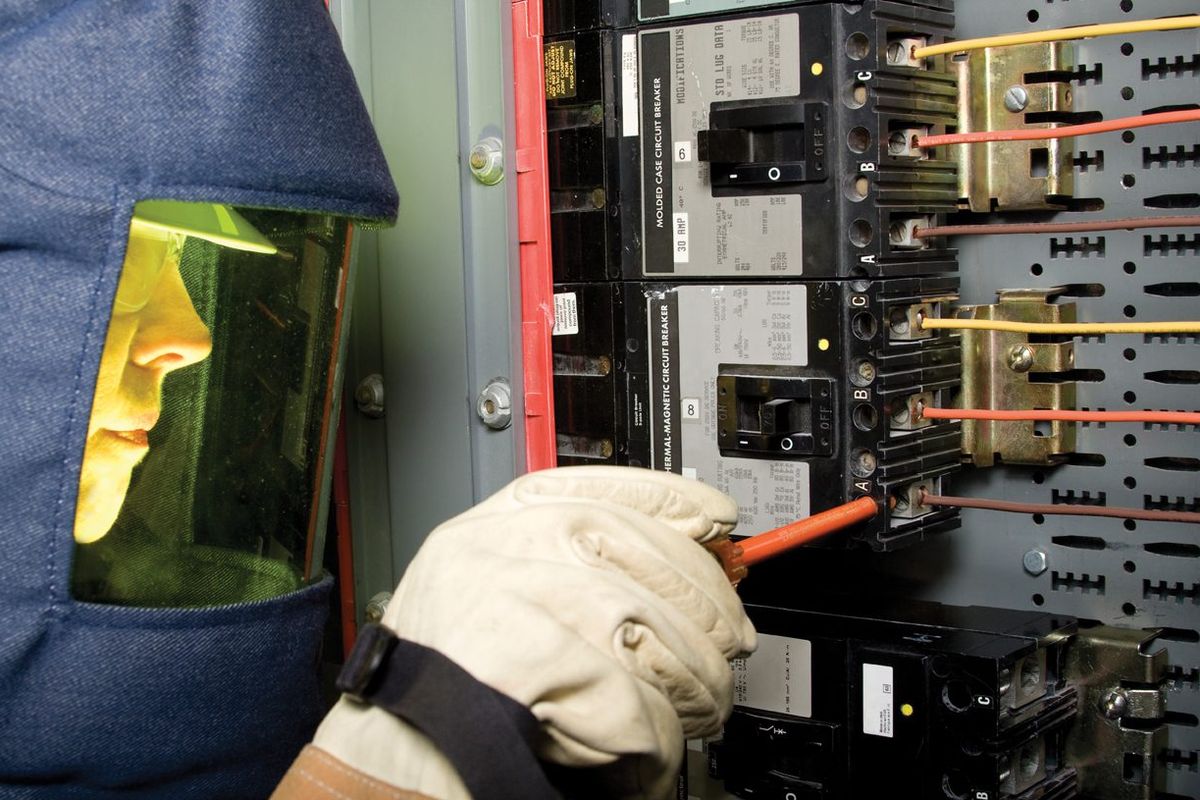
Utility-scale storage and solar
How does VB study DC arc flash on Saudi battery energy storage and solar plants?
VB studies DC arc flash on Saudi battery energy storage and solar plants container by container and inverter by inverter: battery racks and DC combiners up to 1,500 V, the power conversion system, the MV skid and the grid substation. The DC side runs on NFPA 70E Annex D methods, the AC side on IEEE 1584, and the whole plant is labelled from one model.
| Equipment | Voltage | How VB calculates it |
|---|---|---|
| Battery racks and container DC busbars | 1,000 to 1,500 V DC | NFPA 70E Annex D, per rack and per container |
| PV strings and DC combiner boxes | Up to 1,500 V DC | DC method at irradiance and temperature cases the site actually sees |
| Power conversion system and inverters | DC in, LV AC out | DC and AC sides split, both labelled |
| MV skids and collector switchgear | 13.8 kV to 33 kV | IEEE 1584 where in range, named method above it |
| Grid substation and auxiliaries | Up to 132 kV intake | Protection review, labels on every accessible board |
- 1
Walk down live
Container and inverter nameplates, fuse ratings and relay settings captured in ElecTwin, with no plant outage.
- 2
Model for Saudi heat
Summer peaks from Riyadh to the Red Sea coast change cell resistance and PV output, so VB runs the hot and cold cases that set the highest DC energy.
- 3
Label and hand over
Arabic-English labels, printed for outdoor Saudi sun and dust, on every container door and combiner, with a ranked list of fixes that cut the energy.
Working with 800 V DC rack power in an AI hall? See VB's 800 V DC and battery storage arc flash studies.
The pressure is on
Why are Saudi data centre operators booking arc flash studies now?
Saudi data centre operators are booking arc flash studies now because the Kingdom's build-out is landing global tenants, and those tenants bring their own electrical safety standards to every hall they rent. Add insurer recommendations, AI racks that raise fault energy at the PDU, and battery rooms nobody has calculated, and a dated, signed study becomes the document every audit asks for first.
The tenant's standard
Hyperscale and colocation tenants moving into Riyadh, Dammam and Jeddah expect NFPA 70E labels on every board in their hall before their own technicians work there. VB delivers to that standard, in Arabic and English.
The insurer's recommendation
An open arc flash item on a property survey sits there until a study closes it. VB's report and action register give the underwriter the evidence to close it.
The AI hall
The Kingdom's AI build-out means denser racks, bigger transformers, higher fault levels and more energy at the PDU. VB re-runs the model for every new hall, before it energises.
Across the Kingdom
Where does VB run data centre and battery storage arc flash studies in Saudi Arabia?
VB runs data centre and battery storage arc flash studies across the Kingdom: the Riyadh data centre clusters and central-region solar plants, the Dammam, Dhahran and Al Khobar tech parks in the Eastern Province, the Jeddah colocation and cable-landing sites on the Red Sea coast, and the renewable and storage build-out around NEOM and Tabuk.
| Region | Sites VB studies | What usually drives the study |
|---|---|---|
| Riyadh and the central region | Hyperscale and government data centres, utility-scale solar, grid substations | Tenant standard, new hall energisation |
| Dammam, Dhahran and Al Khobar | Enterprise and colocation data centres, industrial power plants | Parent-company standard, insurer survey |
| Jeddah and Makkah | Colocation halls, cable-landing stations, hospital and campus power | Tenant audit, UPS battery replacement |
| NEOM, Tabuk and the Red Sea coast | Solar, wind and battery storage, new-build campus power | Commissioning dossier, owner's engineer review |
| Madinah, Qassim and the south | Regional data centres, solar and substation projects | Audit finding, UPS or battery replacement |
What sets the price
What drives the scope of a Saudi data centre or BESS arc flash study?
Four things drive the scope of a Saudi data centre or BESS arc flash study: the number of AC buses from intake to PDU, the number of DC strings, cabinets or containers, the quality of the drawings and relay data you already hold, and how many operating modes the site runs. The scope builder above turns your answers into a first scope; the estimate in SAR follows by email.
| Driver | How VB keeps it efficient |
|---|---|
| AC bus count | Repeated halls modelled once and copied, then checked against site photos |
| DC strings and containers | Identical racks grouped; worst-case string calculated and the rest confirmed |
| Drawing and relay data quality | ElecTwin walkdown fills gaps in one visit, no repeat trips |
| Operating modes | Utility, generator, bypass and closed-transition run in one model |
| Label languages | Arabic and English standard, printed together from the final run |
Tool expertise
Which software do VB's teams use for Saudi data centre and BESS arc flash studies?
VB has dedicated engineering teams with hands-on expertise in ETAP, SKM PowerTools, CYME, EasyPower, PSS®E and NEPLAN, with ETAP's DC arc flash modules for battery and PV work. Many Saudi data centre operators and power developers standardise on one of them, and VB builds your model in the one your electrical team already maintains. Field data goes straight into ElecTwin.
A hyperscale data centre campus
How does VB cut a Saudi data hall's worst board from 52 to 7.6 cal/cm²?
At a hyperscale-band data centre campus in the Kingdom's central region, modelled with a 33 kV intake, four data halls, 2N UPS and lithium-ion battery cabinets, VB walks down every hall live and labels AC and DC together. Modelled result: worst-case AC incident energy cut from 52 to 7.6 cal/cm², and every battery cabinet given a DC value for the first time, in 9 weeks.
The trigger
A new hyperscale tenant's site standard required NFPA 70E labels on every board in its leased halls, including the UPS battery cabinets, before handover. The existing study was AC only, stopped at the UPS output boards and predated the third and fourth halls.
What the study found
| Finding | Where, and why it matters |
|---|---|
| 14 buses above 40 cal/cm² | Main LV switchboards in generator-parallel mode, where no live work is allowed |
| 96 battery cabinets with no DC value | The labels the tenant asked for could not be printed |
| 2 halls missing from the model | Built after the last study, never added |
| 6 miscoordinations | UPS input breakers set to trip after the upstream feeder |
What VB changed
Maintenance-mode switches on the main LV incomers, zone-selective interlocking between the incomers and the bus ties, and four relay re-gradings within the existing protection. The DC side was calculated string by string on NFPA 70E Annex D methods, and every AC and DC label was printed in Arabic and English from the final run.
| Measure | Before | After |
|---|---|---|
| Worst-case AC incident energy, cal/cm² | 52 | 7.6 |
| Buses above 40 cal/cm² | 14 | 0 |
| Battery cabinets with a DC value | 0 | 96 |
| Data halls in the model | 2 | 4 |
| Arabic-English labels on the gear | 0 | about 650 |
| Weeks, first walkdown to signed report | 9, with no hall taken offline | |
Free, in two working days
What does a Saudi site get back from the scope builder?
The scope builder returns three things within two working days, free: a hall-by-hall or container-by-container scope covering AC and DC, the data list your facilities team needs to have ready, and an estimate in Saudi riyals or US dollars. It is written so you can forward it to your tenant, your insurer or your parent company the same day.
AC and DC scope
Every intake, board, UPS, PDU, battery string and container, with the label count, ready for your facilities head.
The data list
Single-lines, relay settings, UPS and battery datasheets: what VB needs and what it will capture on site.
An estimate in SAR
Line by line, so procurement can raise the order before the tenant's handover date.
Want labels, training and AI-watched PPE compliance on top of the study? See the VB Arc360 programme in Saudi Arabia.
Before you ask
Questions Saudi data centre and battery storage teams ask VB
What does a data centre arc flash study in Saudi Arabia include?
Every point where live gear can be opened, from the 13.8 kV or 33 kV SEC utility intake through the MV ring, transformers, generator paralleling gear, UPS boards, static transfer switches and PDUs, down to the DC side of every UPS battery string. VB models every operating mode, calculates AC on IEEE 1584-2018 and DC on NFPA 70E Annex D, ranks the fixes and labels every board in Arabic and English.
Does IEEE 1584 cover DC battery systems?
No. IEEE 1584-2018 covers three-phase AC from 208 V to 15 kV. For battery strings, battery cabinets, PV combiners and DC busbars VB uses the DC methods in NFPA 70E Annex D, solved in ETAP's DC arc flash modules, and names the method on every DC label.
Can VB study a live Saudi data centre without taking a hall offline?
Yes. VB's walkdown, data capture and modelling run while the halls stay live, under your method statements and change windows. Only label fixing and any relay setting changes need planned access, and VB schedules both into your maintenance windows.
Are PDUs and AI racks a new arc flash risk in Saudi data centres?
They can be, and the Kingdom's AI halls are where it shows first. Denser AI racks bring bigger transformers and higher fault levels, so the energy at the PDU and busway tap-off rises. VB re-runs the model for each new hall and labels down to the PDU, so the numbers on the gear match the load it now carries.
How do you study a battery energy storage system in Saudi heat?
VB captures cell, rack and container data on site, then runs the hot and cold cases that set the highest DC fault current, because summer temperatures in the Kingdom change cell resistance. Each container door and DC combiner gets its own Arabic-English label from the worst case.
Do you calculate DC arc flash on Saudi solar farms?
Yes. PV strings and DC combiner boxes up to 1,500 V are calculated on NFPA 70E Annex D methods at the irradiance and temperature cases the site actually sees, and the inverter, MV skid and grid substation follow on IEEE 1584 in the same model.
What about 800 V DC power in AI data halls?
VB models 800 V DC rack distribution the same way as any DC system: source by source, on a named DC method, with the protection checked for clearing time. For the detail, see VB's 800 V DC and battery storage arc flash page.
Which Saudi cities do you cover?
VB covers the whole Kingdom: Riyadh, Dammam, Dhahran, Al Khobar, Jeddah, Makkah, Madinah, Qassim, Tabuk and the NEOM and Red Sea coast build-out. Survey teams mobilise to each site.
How long does a data centre arc flash study take in Saudi Arabia?
For a multi-hall campus, roughly 8 to 12 weeks from first walkdown to signed report, with labels fixed in your maintenance windows. A single hall or a BESS of a few containers takes three to five weeks. Durations are indicative and confirmed in the scope VB sends back.
Does VB work alongside SBC 401 and the SEC connection requirements?
Yes. Saudi sites are built to SBC 401 and connected under Saudi Electricity Company (SEC) requirements, and VB models the SEC intake and your protection as installed. The arc flash study sits on top: incident energy, boundaries and PPE for every board, on IEEE 1584 for AC and NFPA 70E Annex D for DC.
What happens after I submit the scope builder?
Within two working days a VB power systems engineer emails your AC and DC scope, the data list your facilities team needs and the estimate in Saudi riyals or US dollars. No sales call.
Every board labelled, AC and DC, before your tenant's handover date.
Sixty seconds on the scope builder, and a VB engineer sends an AC and DC scope, the data list and an estimate in SAR within two working days. Riyadh, Dammam, Jeddah or NEOM. Free, by email.
Get price estimateHandover date already set? Email the single-line and the date to connect@groupvb.com with "KSA data centre arc flash" in the subject.