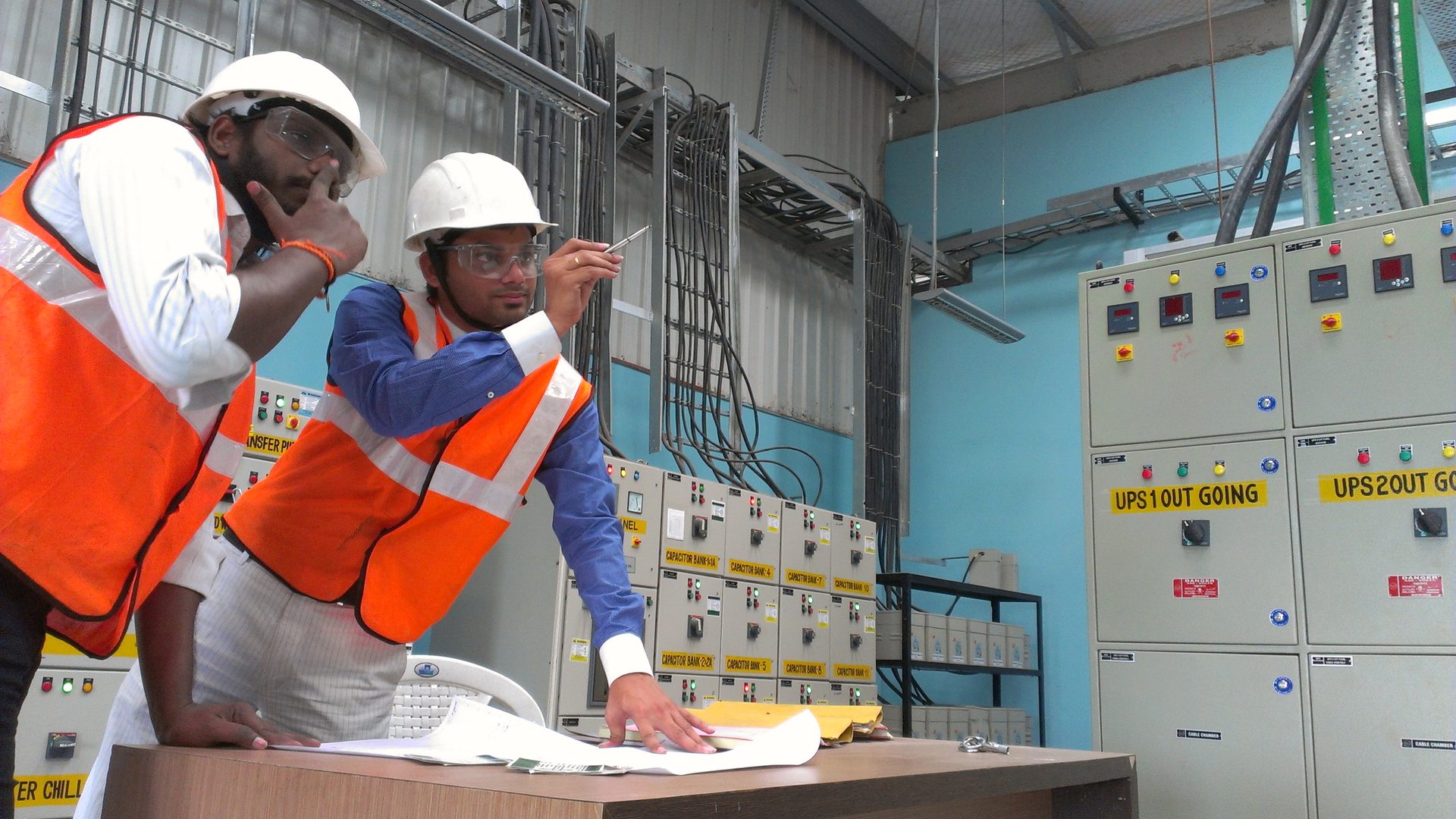
BESS · UPS strings · 800 VDC · NFPA 70E Annex D · ETAP
How VB studies arc flash on battery storage and 800 VDC distribution, from the string to the converter.
Your AC switchgear has labels. Your battery strings, the DC bus and the converter link, where the technician's hands actually go, usually have none. VB puts all four DC levels on one incident energy table, runs every string at the state of charge you operate between, and labels each level to NFPA 70E. Tell the scope builder your architecture and read the lines of your study now; send it and the signed scope is back in two business days.
1,000+ studies21 countriesSince 2014AC and DC on one table
Scope your DC study
| Level 1 | 24 strings · NFPA 70E Annex D.5 · two states of charge · label on each cabinet |
|---|---|
| Level 2 | Container DC bus with parallel strings · Annex D.5 · label on the combiner |
| Level 3 | 4 PCS DC links · transient analysis in ETAP · capacitor discharge and fuse I²t |
| Level 4 | PCS AC side and switchgear · IEEE 1584-2018 · included |
| VB asks for | Battery data sheets, string protection, PCS settings, state-of-charge range, one-line |
| Duration | 4 to 6 weeks from data to installed labels |
Scope lines and durations are VB's standard DC scope, modeled by architecture; the written scope confirms them. Send it and get the scope, the BESS scope note and the signing engineer's name in two business days. Short form, no phone number.
Trusted on plants that cannot stop











- 0DC levels on one incident energy table: string, bus, converter link, AC side
- 0states of charge per string, the worse case labeled
- 0arc flash studies delivered
- 0assets twinned and labeled
- 0countries
Levels and method: VB DC scope standard, October 2026. Study and asset counts: VB Engineering project register.
How the free DC scope works
- 1
Pick the architecture, count the strings
BESS, UPS strings, 800 VDC racks or solar plus storage; strings, racks or containers; PCS count. Two minutes, no fault currents.
- 2
Read the four levels and the method on each
The table rewrites itself into the lines of your study, with the method VB applies on every level and the data VB will ask for.
- 3
Send it, get the signed scope
Written scope by level, duration by phase, the BESS scope note and the name and license state of the signing engineer, in two business days.
The study
What does a battery energy storage system arc flash study cover?
A battery energy storage system arc flash study calculates incident energy and boundaries on every DC level of the installation: cell string, rack or container bus, converter DC link and the PCS AC side. VB Engineering models the strings by the NFPA 70E Informative Annex D.5 method, the converter-fed 800 VDC distribution by time-dependent transient analysis in ETAP, the AC side by IEEE 1584-2018, and labels each level to NFPA 70E 130.5(H) with the study date.
| Level | What it is | Method VB applies | Label | Who usually misses it |
|---|---|---|---|---|
| 1 · Cell strings | Series cells to the string fuse or breaker, in a cabinet or rack | NFPA 70E Annex D.5, run at the upper and lower state of charge, enclosure multiplier where in a cabinet | Each string cabinet or rack door | Bundled OEM studies, AC-only consultancies |
| 2 · Rack or container DC bus | Parallel strings on a combiner or busbar | Annex D.5 with the parallel contribution and the bus protection clearing time | Combiner or bus compartment | Studies that model one string and multiply |
| 3 · Converter DC link | PCS, inverter or rack converter DC side; 800 VDC distribution in an AI hall | Transient analysis in ETAP: capacitor discharge, battery contribution, fuse I²t, millisecond protection | Converter cabinet and 800 VDC busway tap | Nearly everyone; the method is new |
| 4 · PCS AC side and switchgear | Inverter output, transformer, switchgear, grid connection | IEEE 1584-2018, every operating scenario | Switchgear, per cubicle | Covered by most studies; often the only level covered |
The AI hall
How does VB study arc flash on 800 VDC distribution in AI data centers?
As a converter-fed DC system, not as a big battery. In an 800 VDC hall the fault is driven by the capacitor banks in the rack converters and the rectifiers for the first milliseconds, then by whatever source stays connected; the clearing time of the DC protection decides the result, and the battery-string methods written for UPS rooms do not apply. VB models the distribution in ETAP with the time-dependent sources and the protection curves, verifies the as-installed settings on site, and labels the busway taps and converter cabinets. The owner's one published study on the subject, read as an independent engineer would read it, is below.
| What the study found | What it assumed | What VB verifies on your hall |
|---|---|---|
| Incident energy on a well-designed 800 VDC rack distribution can stay comparable to conventional AC and below 1.2 cal/cm² at the rack | The reference architecture: specific capacitor placement, reverse-blocking diodes and millisecond-scale protection | Whether your installed architecture matches the reference, device by device, and what the figure is where it does not |
| Capacitor discharge dictates the first milliseconds of the fault | Capacitor values and ESR as designed | The as-built converter population and capacitance, which change with every rack refresh |
| Legacy battery-backed DC methods overestimate the hazard on converter-fed 800 VDC | Protection clears within the modeled window | As-found protection settings and the clearing time with the real cable impedance, run in ETAP per busway section |
| Rack-level design decisions set the hazard | Design stage | Energization and every expansion: the study date on the label, per NEC 2026 110.16(B) |
Source: the publisher's white paper and press release, 2026, linked at first mention above. VB has no commercial relationship with the publisher and takes no position on the architecture; the reading is of the method.
The variable most studies skip
Does state of charge change the arc flash result on a battery string?
Yes, and in the direction most people do not expect. A string at high state of charge delivers the highest fault current; a string at low state of charge, or with aged cells, has higher internal impedance, so the fault current falls, the string fuse or breaker takes longer to clear, and incident energy can rise. VB runs every string at the upper and lower state of charge the plant operates between, applies the aging impedance the battery supplier publishes, and labels the worse case. The method is printed on the row.
| Variable | What VB asks for | Where it comes from | Effect on the result |
|---|---|---|---|
| State of charge range | Upper and lower operating limits | EMS settings, operating procedure | Sets the fault current window; both ends run |
| Cell aging | End-of-life impedance factor | Battery supplier data sheet | Raises impedance, can lengthen clearing |
| String protection | Fuse class and rating or breaker settings, I²t | As found on site, photographed | Decides clearing time; the largest single driver |
| Cable and bus impedance | Size, length, material per string and bus | Cable schedule, measured on the walkdown | Lowers fault current at the far end |
| Enclosure and working distance | Cabinet dimensions, electrode gap, task distance | Walkdown | Enclosure multiplier under Annex D.5 |
| Capacitor discharge (level 3) | Converter DC link capacitance and ESR | Converter data sheet, as-built count | Governs the first milliseconds on 800 VDC |

Three installations VB scopes most
Every string a DC bus, rectifier and inverter AC sides on the same table, labels on every cabinet door. The commonest gap in a data center study.
Strings, container bus, PCS DC link and AC side; NFPA 855 commissioning file; the insurer's and the EPC's study requirement met before energization.
Converter-fed buses modeled in ETAP with the as-built converter population; labels on busway taps and converter cabinets; re-run at every expansion.
The rules
Which standard applies to arc flash on batteries and DC?
NFPA 70E applies: Article 130.5 requires the arc flash risk assessment on any conductor above 50 V, AC or DC, and Informative Annex D.5 gives the DC incident energy method. IEEE 1584-2018 covers the AC side only, 208 V to 15 kV. NFPA 855 requires the installation to meet NFPA 70E and sets separation, access and signage rules without giving a method. OSHA 1910.333 and the general duty clause make the employer responsible for the assessment. VB cites every clause on the report page it answers.
| Standard | What it covers on a BESS or DC system | Where VB applies it |
|---|---|---|
| NFPA 70E 130.5 and Annex D.5 | Risk assessment above 50 V DC; DC incident energy method; label content 130.5(H); five-year review 130.5(G) | Levels 1 and 2, every label, the review trigger list |
| IEEE 1584-2018 | AC incident energy, 208 V to 15 kV | Level 4 only |
| NFPA 855 | Installation of stationary energy storage; requires NFPA 70E compliance; signage, separation, access | Commissioning file, label placement, the AHJ conversation |
| IEEE 946 | DC auxiliary power systems; battery short-circuit practice | String short-circuit data where the supplier gives none |
| UL 9540 and UL 9540A | ESS listing and thermal runaway test | Context only; not an arc flash method |
| NEC 2026 110.16(B) | Study date on the label | Every VB label |
| OSHA 29 CFR 1910.333 | Employer's duty to assess and protect | The certification page, signed by the engineer of record |
Why VB on the DC side
Written by the team that puts AC and DC on one table
String, bus, converter link and AC side on the same incident energy table, the method named on every row.
Upper and lower operating limits run, aging applied, the worse case on the label.
Time-dependent sources and protection curves for 800 VDC and PCS DC links. No spreadsheet, no hand calculation.
Named before award; a chartered engineer outside the US. The three-signature chain on page one.
Every string fuse and converter photographed into VB's own app, current for the expansion and the five-year review.
Send the OEM's or the EPC's study and VB tells you which of the four levels it covers.

A scoped DC study
What did four levels find that one level had missed?
On a modeled utility-scale BESS in the US Southwest, 96 strings in 12 containers, 6 PCS, the EPC's bundled study had labeled the PCS AC side and nothing else. VB's four-level study put 114 DC buses on the table. At the lower state of charge, 18 strings cleared slower than at the upper and crossed into a higher PPE category; two container buses had parallel-string contributions that doubled the single-string figure; the PCS DC links, run as transient cases in ETAP, governed the label on all six converter cabinets. 114 DC labels were installed where there had been none. Modeled, illustrative: indicative of an installation of this shape, not a measurement of any one site.
| Level | Buses | Labeled before | Finding | Labeled after |
|---|---|---|---|---|
| 1 · Strings | 96 | 0 | 18 strings worse at low state of charge | 96 |
| 2 · Container buses | 12 | 0 | 2 buses doubled by parallel contribution | 12 |
| 3 · PCS DC links | 6 | 0 | Transient case governs all 6 | 6 |
| 4 · AC side | 22 | 22 | Settings confirmed, 3 re-labeled with the study date | 22 |
| Total | 136 | 22 | 136 |
Where the DC study goes next
What else sits on the same DC table?
How VB calculates DC incident energy
The NFPA 70E Annex D.5 method as VB runs it in ETAP and SKM, and a DC scope estimator. DC arc flash incident energy calculation.
What the whole study costs
Engineering per bus, DC buses as their own line, options for data collection and labels. Arc flash study cost.
The scope of work
Four tasks, the pre-visit data sheet, a spec template and an RFP outline, DC lines included. Arc flash study scope of work.
Before you energize
Questions owners and EPCs ask VB about BESS and 800 VDC arc flash
What is a battery energy storage system arc flash study?
A study that calculates incident energy and the arc flash boundary on every DC level of a battery installation, not only the AC switchgear: the cell string, the rack or container bus, the converter DC link and the PCS AC side. VB Engineering models the strings by the NFPA 70E Informative Annex D.5 method, the converter-fed buses by transient analysis in ETAP, and puts every level on the same incident energy table with its own label. A BESS with labels on the AC side only is half studied.
Does OSHA require an arc flash study on a BESS?
OSHA 29 CFR 1910.333 and the general duty clause require the employer to protect workers from recognized electrical hazards and to assess them; NFPA 70E 130.5 is how that assessment is done and it applies to DC above 50 V. NFPA 855 and the AHJ add the installation rules. In practice the insurer and the EPC contract ask for the study before energization, which is why most BESS studies VB scopes are commissioning-driven.
Is IEEE 1584 enough for a battery storage system?
No. IEEE 1584-2018 is validated for AC from 208 V to 15 kV and covers the PCS AC side and the grid connection. It gives no method for the DC strings, the DC bus or the converter DC link, which is where the technician's hands go. VB applies IEEE 1584-2018 on the AC side and the NFPA 70E Annex D.5 method on the battery side, and names the method on every row of the table.
What is 800 VDC power in a data center?
A rack power architecture in which the facility distributes direct current at a nominal 800 V to the IT rack, with conversion to the server voltage at the rack, instead of distributing AC and converting in each power supply. It is being adopted for high-density AI halls because it cuts conversion losses and copper. It also puts a continuous DC source in every row, which is why arc flash on 800 VDC distribution needs its own study line.
Does state of charge change the arc flash result on a battery string?
Yes. A string at high state of charge delivers more fault current; a string at low state of charge or with aged cells has higher internal impedance, so the fault current drops and a fuse or breaker can take longer to clear, which can raise incident energy rather than lower it. VB runs each string at the upper and lower state of charge the owner operates between and labels the worse case.
How does VB study UPS battery strings?
Each string is a DC bus in the model, with its short-circuit rating from the battery data sheet, the string fuse or breaker with its clearing time, the cabinet dimensions and the working distance. The Annex D.5 method gives the incident energy; the enclosed-cabinet multiplier is applied where the string sits in a cabinet; the label goes on the cabinet door. VB's UPS study covers the rectifier and inverter AC sides on the same table.
Do battery cabinets and racks need arc flash labels?
Yes, where a worker can be exposed to the DC terminals above 50 V, which is every string cabinet and rack. NFPA 70E 130.5(H) sets the label content; VB adds the study date so the label is readable at inspection under NEC 2026 110.16(B). A BESS commissioned without DC labels is the most common finding on VB's reviews of bundled studies.
What does NFPA 855 say about arc flash?
NFPA 855, the standard for the installation of stationary energy storage systems, requires the installation to comply with NFPA 70E for electrical safety and sets separation, access and signage requirements; it does not give an arc flash method. The arc flash study is the NFPA 70E piece that NFPA 855 and most AHJs expect to see in the commissioning file, next to the UL 9540 listing and the hazard mitigation analysis.
What does VB need to start a BESS or 800 VDC study?
The one-line in any state, the battery data sheets (short-circuit rating, string configuration), the PCS or rack converter settings, the string protection (fuse class and rating or breaker settings), the cabinet or rack dimensions, and the state-of-charge range the plant operates between. The scope builder on this page lists the lines; the pre-visit data sheet, sent with the scope, lists every field. What is missing, VB collects on site.
What happens after I send the scope?
A VB practice engineer reads your architecture, string or rack count and converter count, replies within two business days with the written scope by DC level, the method per level, the variables VB will ask for, the duration by phase and the name and license state of the signing engineer. No call unless you ask for one. Already hold a BESS study? Send it and VB tells you free which DC levels it covers.
Four DC levels, two states of charge, one table, labels on every door.
Build the scope above and send it. A VB practice engineer returns the written scope by level, the BESS scope note and the signing engineer's name in two business days. Already hold a study? Send it and VB tells you which levels it covers, free.
Scope my DC systemPrefer email? Write to connect@groupvb.com with the string count in the subject line.