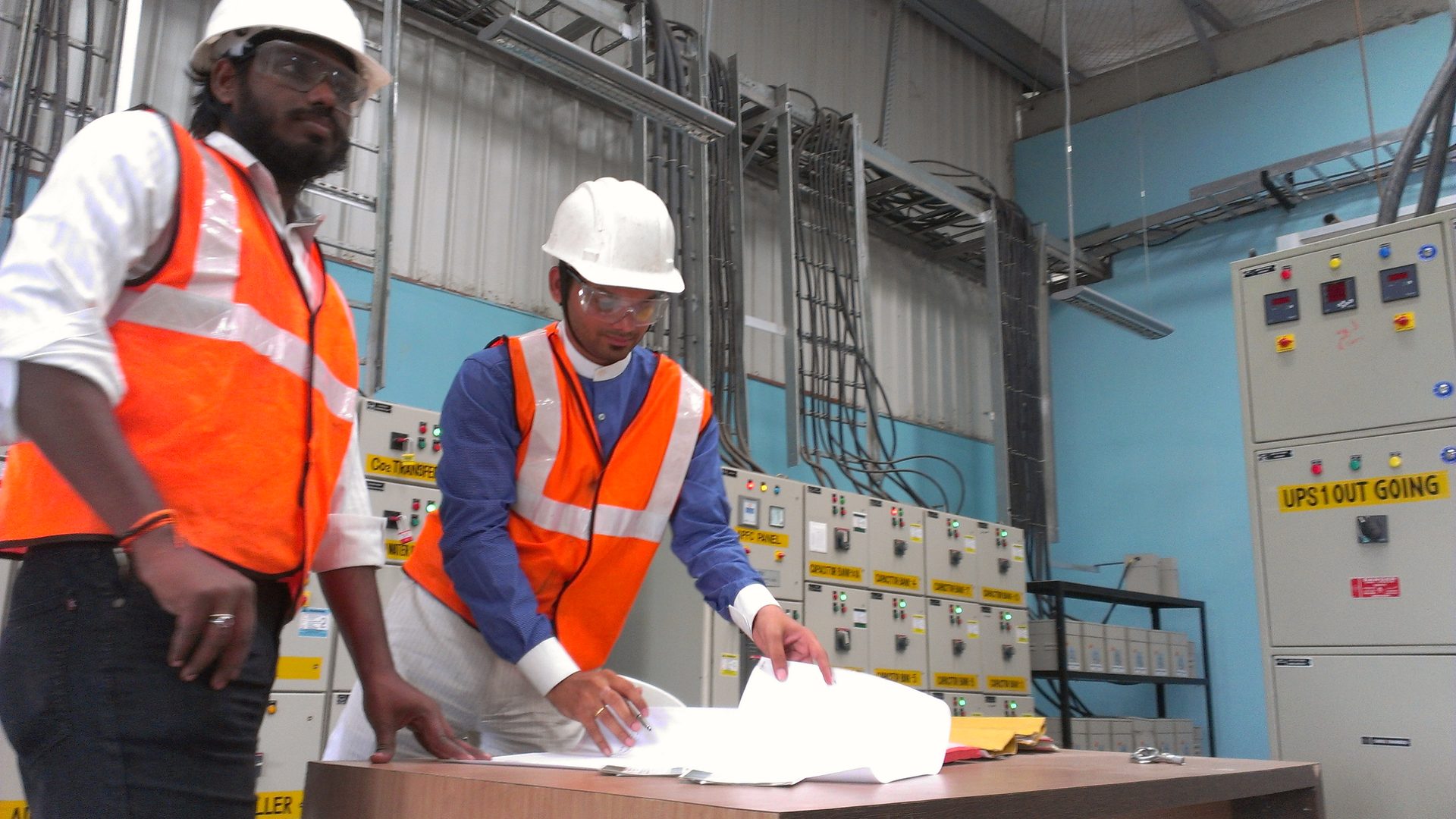
Scope of work · CSI 26 05 73 · NFPA 70E 130.5 · IEEE 1584.1
How VB scopes an arc flash study for a data center, and the checklist, spec template and data sheet to start yours.
Four tasks, written the way an RFP reads: field data and one-line verification, the ETAP or SKM model with short-circuit and coordination, incident energy and labels to IEEE 1584 and NFPA 70E, and a PE-signed report with a conformance matrix against your specification. Enter your bus count on the right and read your scope and duration now; send it and the three documents come back in two business days, free.
1,000+ studies21 countriesSince 2014PE-signed in your state
Build your scope of work
| Task 1 | Field data collection and one-line verification at 60 buses; one-line reconciled on site |
|---|---|
| Task 2 | ETAP or SKM model, short-circuit and coordination study, every operating scenario |
| Task 3 | Incident energy to IEEE 1584-2018 at 60 buses; labels to NFPA 70E 130.5(H) installed and photographed |
| Task 4 | PE-signed report, IEEE 1584.1 format, conformance matrix, settings recommendations |
| Duration | 5 to 7 weeks from site access to installed labels |
Durations are modeled from VB's project register by bus-count band (assumptions under the table below). Send the scope and VB returns the written version, the pre-visit data sheet, the 26 05 73 spec template and the RFP outline in two business days. Short form, no phone number.
Trusted on plants that cannot stop











- 0tasks in every VB scope of work, each with its own line
- 0data categories on the pre-visit data sheet
- 0arc flash studies scoped and delivered
- 0assets twinned and labeled
- 0countries
Study and asset counts: VB Engineering project register. Task and data-category counts: VB scope template, October 2026.
How the scope builder works
- 1
Enter five things you already know
Sites, bus count, highest voltage, the state of your one-lines and whether DC is in. No fault currents, no settings.
- 2
Read the four tasks and the duration
The table rewrites itself as a scope you can paste into an RFP, with the duration band and the extra line for drawings or DC.
- 3
Send it and get the three documents
The written scope, the pre-visit data sheet, the CSI 26 05 73 specification section and the RFP outline, reviewed by a VB practice engineer, in two business days.
The scope
What does VB include in an arc flash study scope of work?
VB Engineering scopes an arc flash study in four tasks: field data collection and one-line verification, short-circuit and protective device coordination modeling in ETAP or SKM PowerTools, incident energy calculation to IEEE 1584-2018 with labels to NFPA 70E 130.5(H), and a PE-signed report in the IEEE 1584.1-2022 format with a conformance matrix against your specification. A 25-bus site takes about four weeks from site access to installed labels.
| Task | What VB does | What you provide | Output |
|---|---|---|---|
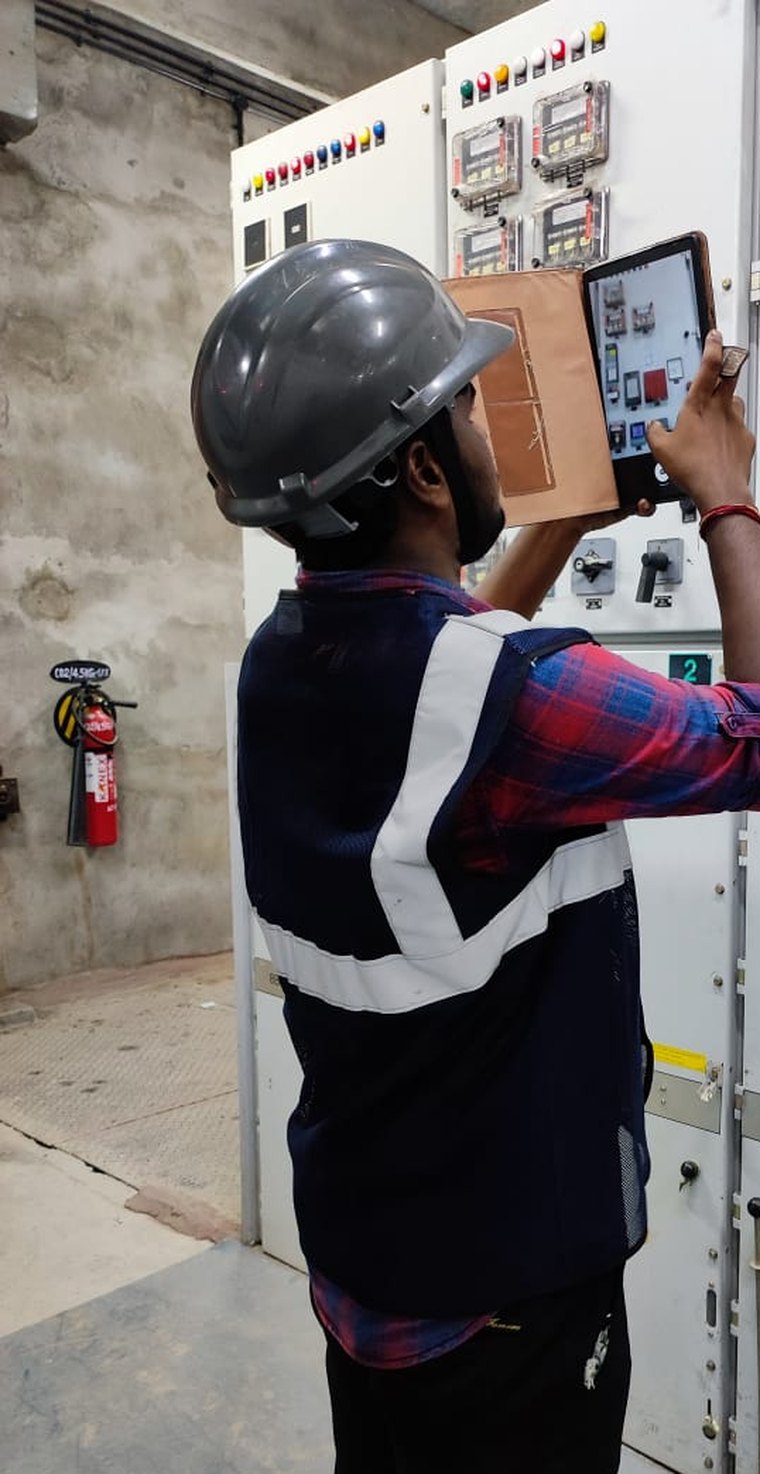
| 1 · Field data and one-line | Opens every cubicle in scope; records nameplates, trip settings, fuse types, conductor size and length, enclosure dimensions and electrode configuration; photographs each device in ElecTwin®, VB's own field data capture app, so nothing is transcribed from paper; reconciles the one-line or draws it | Escort, access, the one-line in any state, the utility letter or permission to request it | Verified one-line, field data register in ElecTwin, photo set |
| 2 · Model and studies | Builds the model in ETAP or SKM PowerTools; short-circuit study (bolted and arcing) at every bus; protective device coordination with time-current curves for every operating scenario on the one-line | Operating scenarios you run (utility, generator, tie closed, UPS bypass) | Model file reference, short-circuit and coordination results |
| 3 · Incident energy and labels | Incident energy and arc flash boundary at the working distance for every bus and scenario, worst case governs; labels to NFPA 70E 130.5(H) with the study date; printed, installed, photographed | Label placement agreed on the walkdown | Incident energy table, label schedule, installed-label photographs |
| 4 · Report and sign-off | Report in the IEEE 1584.1-2022 format; independent review; signature and stamp by a professional engineer licensed in the facility's state; conformance matrix against your specification; settings and mitigation recommendations | Your specification, if you have one | Signed report, conformance matrix, recommendations |
Before the site visit
What information does VB need before the site visit?
Seven categories, and most sites hold four of them already. VB's pre-visit data sheet lists each one with where it is usually found, so the plant's own electrical team can fill it in an afternoon and the walkdown shortens by days. Anything missing is collected on site and the scope says which lines VB will fill.
| Category | What VB asks for | Where it usually is |
|---|---|---|
| Utility source | Available fault current, X/R ratio, service voltage | The utility's short-circuit letter; VB requests it if absent |
| Transformers | kVA, primary and secondary voltage, percent impedance, winding connection, tap | Nameplates; VB photographs them on the walkdown |
| Conductors | Size, length, material, raceway type for every feeder in scope | Cable schedules, as-built drawings; measured on site where absent |
| Protective devices | Manufacturer, model, frame, trip unit type and the as-found settings; fuse class and rating; relay CT ratio and settings | Settings sheets, commissioning records; read from the device on site |
| Equipment and enclosures | Equipment type, enclosure dimensions, electrode configuration, working distance | Measured on the walkdown to IEEE 1584-2018 |
| Grounding | Solidly grounded, resistance grounded or ungrounded, per system | One-line, transformer nameplates |
| One-line diagrams | Any version, any age, in any format | The facilities office; VB reconciles or draws it |

What the data sheet does for you
- Shortens the walkdown · every line the plant fills is a cubicle VB does not have to trace from scratch
- Fixes the scope before award · the bus count and the drawings state are on paper, so no change order later
- Doubles as the RFP attachment · bidders answer the same sheet, so proposals compare line for line
- Lands in ElecTwin · every line goes into VB's field data app, 15 component classes from utility to motor, and stays current for the five-year review
- Is free with the scope · one form, three documents, two business days
For the engineer of record
How does VB write the arc flash study into your specification?
VB supplies the study as a specification section in the CSI MasterFormat 26 05 73 structure (the current number for the overcurrent protective device arc flash study; older project manuals carry it as Section 16040). Part 1 names the standards and the engineer's qualification, Part 2 the software and the label material, Part 3 the field method, the studies, the report and the labels. The engineer of record pastes it into the project manual; an owner uses it as the standard across every site. VB names ETAP or SKM PowerTools and the IEEE 1584-2018 edition in the section, so every bidder models the same way.
| Part | Article | What the VB template specifies |
|---|---|---|
| Part 1 · General | Summary | Short-circuit study, protective device coordination study and arc flash study as one scope; buses in and out by voltage class |
| References | IEEE 1584-2018, IEEE 1584.1-2022, NFPA 70E (current edition), NEC 110.16, IEEE 242 and IEEE 141 for coordination and short-circuit practice | |
| Submittals | Field data register, model file reference, draft report, final signed report, label schedule, installed-label photographs | |
| Quality assurance | Study performed by an engineering firm with 1,000 or more studies delivered; signed and stamped by a professional engineer licensed in the project state; independent review by a second engineer | |
| Part 2 · Products | Software | ETAP or SKM PowerTools, version stated in the report; no spreadsheet or hand calculation accepted |
| Labels | Content to NFPA 70E 130.5(H) including the study date; material and adhesive rated for the enclosure environment | |
| Part 3 · Execution | Field data | Every device in scope opened and photographed; settings as found, captured in a structured field data application (VB uses ElecTwin); one-line reconciled or drawn |
| Studies | Every operating scenario on the one-line; worst case governs the label; IEEE 1584-2018 for AC, NFPA 70E Annex D.5 for DC where in scope | |
| Report | IEEE 1584.1-2022 content, conformance matrix against this section, recommendations with the incident energy before and after each one | |
| Labels | Installed by the study firm, photographed, listed by equipment identifier |
For the buyer
What should an arc flash study RFP ask for?
Six headings decide whether the proposals you receive can be compared: the facility and bus count by voltage class, the state of the drawings, the four tasks with the deliverable for each, the qualification of the signing engineer, the schedule by phase, and the basis of pricing per bus. An RFP that lists these receives proposals that line up; one that says "provide an arc flash study" receives six different studies at six different prices. VB's RFP outline, sent with the scope, has the six headings written and the qualification clauses filled in.
The seven data categories with "where to find it" and a tick box per line. The plant fills what it holds; VB fills the rest on site. Attach it to the RFP so every bidder prices the same facts.
Parts 1 to 3 in CSI structure, standards, software and PE qualification named. Paste into the project manual or adopt as the owner's standard.
Six headings, the qualification clauses (PE licensed in the state, independent review, software named, IEEE 1584.1 report), the evaluation table and the per-bus pricing basis.
When the RFP goes out before energization
On a new data center hall or an expansion, the arc flash study belongs in the commissioning schedule, not after it: the labels must be on the doors before the first energized work, and the settings the study recommends are easiest to apply before the breakers are in service. VB scopes new-build studies from the design one-line and the manufacturer's settings, then verifies on site at energization and issues the labels the same week. The RFP outline carries the commissioning version of the schedule.
Qualification clauses VB recommends
- Signing engineer · professional engineer licensed in the project state, named in the proposal
- Independent review · a second engineer who did not build the model signs the review
- Software · ETAP or SKM PowerTools, version in the report; no spreadsheets
- Report format · IEEE 1584.1-2022 content with a conformance matrix
- Experience · studies delivered, with three described by plant type and bus count
Schedule
How long does an arc flash study take?
About four weeks for a site of 25 buses with current drawings, and twelve weeks or more above 300 buses, measured from site access to installed labels. The field phase sets the pace: it runs one to four weeks depending on bus count and whether the one-line has to be reconciled, and nothing downstream can start before it ends. Modeling and review are the steadiest phases; label printing and installation add one to two weeks at the end. The table gives VB's bands by bus count.
| Buses in scope | Field data and one-line | Model, short-circuit, coordination | Incident energy and review | Labels and signed report | Total |
|---|---|---|---|---|---|
| Up to 25 | 2 to 3 days | 4 to 5 days | 3 days | 5 days | About 4 weeks |
| 26 to 100 | 1 to 2 weeks | 1 to 2 weeks | 1 week | 1 to 2 weeks | 5 to 7 weeks |
| 101 to 300 | 2 to 4 weeks | 2 to 3 weeks | 1 to 2 weeks | 2 weeks | 8 to 11 weeks |
| Above 300 | 4 weeks or more, in parallel crews | 3 to 4 weeks | 2 weeks | 2 to 3 weeks | 12 weeks or more |
What comes back
What does VB deliver at the end of the study?
Seven deliverables, each traceable to a task in the scope: the verified one-line, the field data register with photographs, the incident energy and boundary table for every bus and scenario, the label schedule with installed-label photographs, the signed and stamped report in the IEEE 1584.1-2022 format, the conformance matrix against your specification, and the settings and mitigation recommendations with the incident energy before and after each one. The report names the software and version, the model file, the walkdown dates and the three signatures.
| Deliverable | Format | Who uses it |
|---|---|---|
| Verified one-line | CAD and PDF, revision-marked | Facilities, the next study |
| Field data register and photo set | Structured record in ElecTwin® by equipment identifier, exportable; image folder | Facilities, the reviewer, the next study |
| Incident energy and boundary table | Every bus, every scenario, worst case flagged | EHS, the label schedule |
| Label schedule and installed-label photographs | Equipment identifier, label content, photograph | EHS, the AHJ, the insurer |
| Signed and stamped report | IEEE 1584.1-2022 content, PE stamp, OSHA 1910.132(d) certification page | The owner, the insurer, the auditor |
| Conformance matrix | Every clause of your specification against the page that answers it | The engineer of record, procurement |
| Recommendations | Each with the incident energy before and after, and the device it changes | Operations, the next capital plan |
A scoped study, modeled
On a modeled hyperscale data center campus in the US Southeast, 180 buses across two halls and the central plant, with one-lines three revisions behind and twelve DC strings in scope: the field phase took 15 days with two crews, one-line reconciliation found eleven discrepancies, the model ran four operating scenarios, and the labels were installed in week nine. The conformance matrix answered 46 clauses of the owner's specification, two of them with exceptions stated. Modeled, illustrative: indicative of a study of this shape, not a measurement of any one site.
The checklist
What should you check before awarding an arc flash study?
Twenty lines, free to use. If a proposal cannot answer every line, the scope is not written yet. VB's own scope answers all twenty, which is why the list is published here rather than behind the form.
- Bus count by voltage class is stated, not "the facility"
- Every operating scenario on the one-line is listed
- One-line state is stated and reconciliation is a separate line
- DC buses are in or out, by name
- Field method says every cubicle opened and photographed
- Settings as found are recorded, not taken from drawings
- Utility letter is current or will be requested
- Software and version are named; no spreadsheets
- IEEE 1584-2018 is the AC method; Annex D.5 for DC
- Worst case governs each label
- Label content follows NFPA 70E 130.5(H) with the study date
- Labels are installed and photographed by the study firm
- Report format follows IEEE 1584.1-2022
- Signing engineer is a PE licensed in the project state, named
- Independent review is a signed page, not a tick
- OSHA 1910.132(d) certification is a page in the report
- Conformance matrix against the specification is included
- Recommendations carry incident energy before and after
- Durations by phase are stated, with the field phase first
- Pricing basis per bus with reconciliation, DC and travel as lines
Why the scope holds
Written by the team that has scoped 1,000+ studies
Every VB scope separates field, model, labels and report, so a change in one does not move the price of the others.
VB models in ETAP or SKM PowerTools and names the version. No spreadsheet, no hand calculation, no estimate.
Signed and stamped by a professional engineer licensed where the facility stands, named before award. Chartered engineers outside the US.
Reconciliation is a scope line with its own days. The verified one-line is the first deliverable, not a by-product.
VB captures every nameplate and setting in its own ElecTwin app, online or offline. The model persists, so the five-year review starts from current data instead of a fresh survey.
VB installs the labels and hands back a photograph per equipment identifier, so the proof is in the file.
An independent VB engineer re-checks the utility figure, the settings and the scenarios and signs a findings page before the PE stamps.
Data sheet, 26 05 73 section and RFP outline come with the scope. Use them with any bidder.
Where the scope goes next
What else sits on the same scope?
The report the scope produces
What the signed study must contain under IEEE 1584.1-2022, section by section, and a free review of the report you hold. Arc flash study report.
Who signs it
A PE licensed in your state, an independent reviewer and the modeling engineer: the three names on page one. Who can perform an arc flash study.
DC buses in the scope
UPS strings, battery cabinets and DC distribution calculated by the NFPA 70E Annex D.5 method. DC arc flash calculation.
Before you write the RFP
Questions buyers ask VB while scoping an arc flash study
What does an arc flash study consist of?
Four tasks. Field data collection and one-line verification at every bus in scope; a power system model in ETAP or SKM PowerTools with a short-circuit study and a protective device coordination study; incident energy and arc flash boundary calculation to IEEE 1584-2018 for every bus and operating scenario, with labels to NFPA 70E 130.5(H); and a PE-signed report in the IEEE 1584.1-2022 format with a conformance matrix against your specification. VB writes all four into the scope before award so nothing is assumed.
How is an arc flash study performed?
VB's engineers walk the site with your one-lines and the pre-visit data sheet, open every cubicle in scope, record nameplates, settings, conductor sizes and lengths in VB's ElecTwin field data app, and photograph each device. The data goes from ElecTwin into ETAP or SKM PowerTools, where the model is run for every operating scenario on the one-line. An independent VB reviewer checks the model, a professional engineer licensed in your state signs it, and VB prints and installs the labels. No hand calculations and no spreadsheets at any step.
What is required for an arc flash study to start?
A one-line diagram in any state (current, outdated or missing), the utility's available fault current letter or permission for VB to request it, access to the switchgear rooms with a plant escort, and a bus count by voltage class. If the one-line is missing, VB draws it during the walkdown and the scope says so. The pre-visit data sheet lists everything else, and most of it is optional at the start.
How do I complete an arc flash study on a site with outdated drawings?
Tell VB at scoping. The walkdown then includes one-line reconciliation: every bus, feeder and protective device is traced and the drawing is corrected before the model is built. On a 2026 modeled example of 180 buses, reconciliation added about four field days and found eleven discrepancies that would have put wrong figures on labels. The scope carries the extra days as a separate line so you can see what the drawings cost.
How long is an arc flash study good for?
NFPA 70E 130.5(G) requires the study to be reviewed at intervals not exceeding five years and whenever a change to the system could affect the result: a new transformer, changed settings, a new generator tie, a new UPS string. NEC 2026 110.16(B) puts the study date on the label, so an inspector can read it from the aisle. VB's scope includes the review trigger list and the date on every label.
Does the scope include arc flash labels?
Yes, as a separate task with its own line. VB prints labels to NFPA 70E 130.5(H) with the nominal voltage, incident energy at the working distance, arc flash boundary, the shock boundaries, the equipment identifier and the study date, installs them on every bus in scope, and photographs each installed label. The photograph set is a deliverable, so the plant can prove every label is on the right door.
Can VB write the arc flash study into our specification?
Yes. VB supplies a specification section in the CSI MasterFormat 26 05 73 structure (Part 1 General, Part 2 Products, Part 3 Execution) naming the standards, the software, the PE qualification, the field data method, the report format and the label content. Engineers of record paste it into the project manual; owners use it as the standard for every site. It is one of the three documents behind the form on this page.
Is DC equipment in the scope of work?
Only if you put it there, and VB asks. IEEE 1584-2018 is validated for AC from 208 V to 15 kV; UPS strings, battery cabinets and DC distribution are calculated by the NFPA 70E Annex D.5 method and listed as their own scope line. Tick DC in the scope builder and the four-task table adds the DC buses. VB's DC method is described on the DC arc flash calculation page.
Is the price in the scope of work?
The scope VB sends after the form carries the basis of pricing: per bus by voltage class, with the one-line reconciliation, DC buses, label installation and travel as separate lines, so you can compare it with any other proposal line for line. The figure itself is given in the scope, not on this page, because it depends on the bus count and the drawings you hold.
What happens after I send the scope?
A VB practice engineer reads the scope builder output you sent, checks it against your answers on drawings and DC, and replies within two business days with the written scope, the duration by phase, the deliverable list, the name and license state of the signing engineer, and the three documents: the pre-visit data sheet, the 26 05 73 specification template and the RFP outline. No call unless you ask for one.
Four tasks, four lines, three documents. Your scope in two business days.
Build the scope above and send it. A VB practice engineer returns the written scope, the pre-visit data sheet, the 26 05 73 specification section and the RFP outline, free, with the signing engineer named.
Build my scopePrefer email? Write to connect@groupvb.com with the bus count in the subject line.